
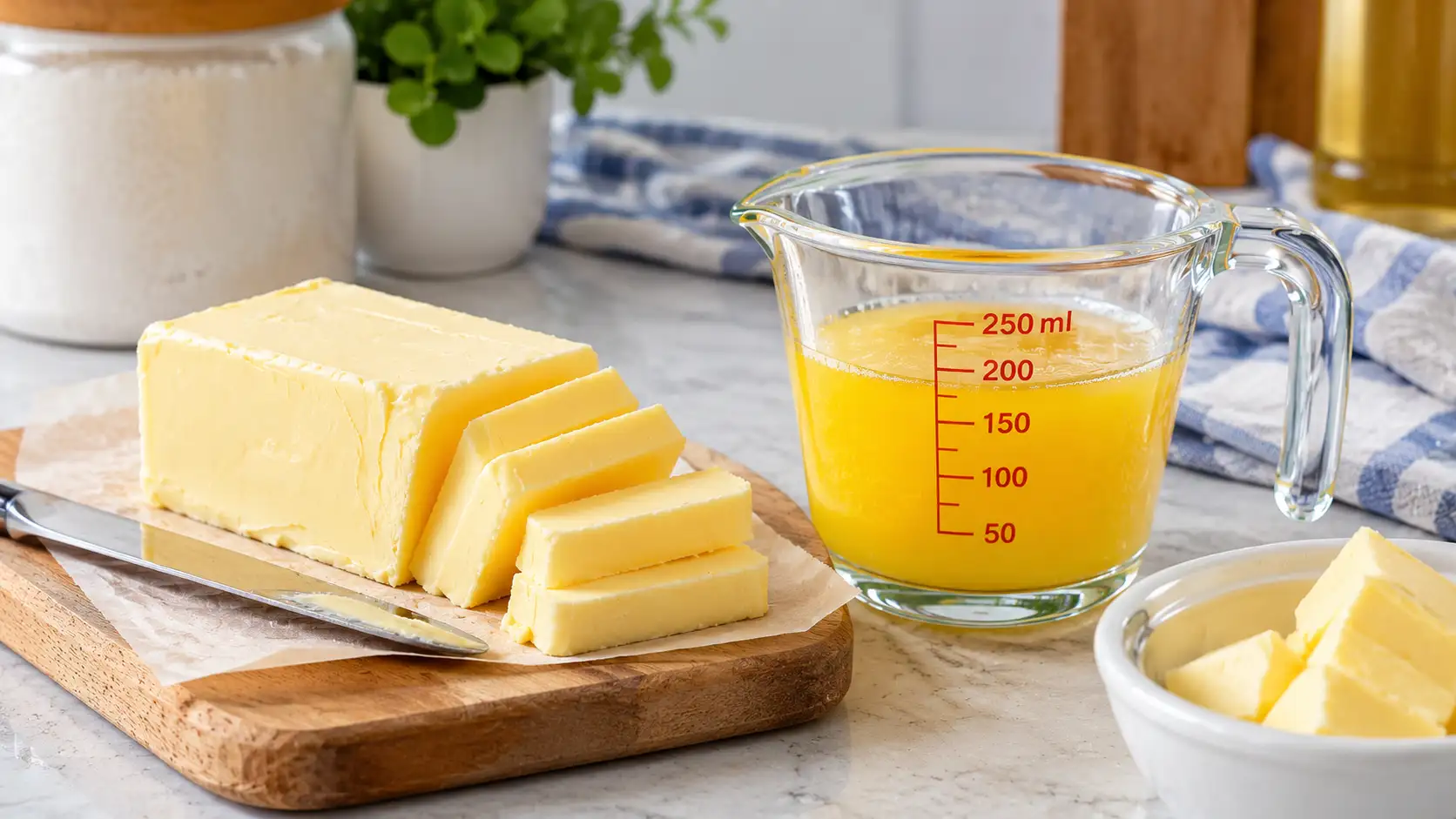
Butter is a common ingredient in cakes, cookies, sauces, and many homemade dishes. However, recipes do not always use the same measuring units. One recipe may list butter in grams, while another asks for milliliters or tablespoons.
If you have ever wondered how much space a certain amount of butter takes up, this guide will help. Below, you will find a butter grams to mL conversion chart, simple examples, and a formula for estimating the volume of butter.
Butter Grams to ML Conversion Chart
Butter is less dense than water, so 100 grams of butter does not occupy exactly 100 mL. For a general estimate, melted butter has a density of approximately 0.91 to 0.94 grams per milliliter, depending on its composition and temperature.
The chart below uses an approximate density of 0.91 g/mL for melted butter.
| Butter (Grams) | Approximate Volume (ML) |
|---|---|
| 10 g | 11 mL |
| 25 g | 27 mL |
| 50 g | 55 mL |
| 75 g | 82 mL |
| 100 g | 110 mL |
| 125 g | 137 mL |
| 150 g | 165 mL |
| 200 g | 220 mL |
| 250 g | 275 mL |
| 300 g | 330 mL |
| 350 g | 385 mL |
| 400 g | 440 mL |
| 450 g | 495 mL |
| 500 g | 549 mL |
Note: These values are approximate and are intended for melted butter. Solid butter can have a different apparent volume because of its physical structure and the way it is packed.
How Many ML Is 100 Grams of Butter?
100 grams of melted butter is approximately 110 mL when using a density of 0.91 g/mL.
This measurement can be useful when preparing sauces, cake batter, or other recipes that call for butter by weight. However, if the recipe specifically asks for 100 grams, using a kitchen scale is generally the most reliable approach.
How Many ML Is 50 Grams of Butter?
50 grams of melted butter is approximately 55 mL.
This is a useful amount for small baking recipes, pan sauces, and other dishes that require a modest quantity of butter.
Remember that this estimate applies to melted butter. If you are measuring cold butter, use the weight markings on the package or weigh it directly rather than relying on a liquid-volume conversion.
How Many ML Is 250 Grams of Butter?
250 grams of melted butter is approximately 275 mL using the same density estimate.
This amount may be useful when preparing larger batches of cookies, cakes, or other baked goods. Because butter composition can vary, treat the volume as a guide rather than an exact measurement.
How to Convert Butter Grams to ML
Converting grams to milliliters requires the density of the ingredient. For melted butter, you can use an estimated density of 0.91 g/mL.
Formula:
Milliliters = Grams ÷ Density (g/mL)
For example, to convert 200 grams of melted butter:
200 ÷ 0.91 = 219.78 mL
Therefore, 200 grams of melted butter is approximately 220 mL.
You can use this formula for other amounts, but make sure to use the correct density for the ingredient you are measuring.
For a quick estimate, visit the Grams to ML Converter. For butter and other ingredients, remember that an accurate conversion depends on the density used.
Does Solid Butter Have the Same Volume as Melted Butter?
Not necessarily. Solid butter and melted butter behave differently when measured by volume.
When butter melts, its structure changes and trapped air spaces may be reduced. This means a volume measurement of solid butter may not correspond exactly to the same volume of melted butter.
For everyday cooking, weighing butter before melting it is a reliable way to get the amount your recipe requires. If a recipe calls for melted butter, follow its instructions about whether the butter should be weighed before or after melting.
Butter Grams to ML vs. Grams to Tablespoons
In the United States, butter is often measured in tablespoons or sticks rather than milliliters. These measurements can be useful, but they are not interchangeable without considering the ingredient and its state.
For reference, one US tablespoon holds approximately 14.8 mL. Using the melted-butter density above, 100 grams of butter is approximately 7.4 US tablespoons by volume.
Butter packaging also commonly provides weight markings, making it easier to measure the amount needed without converting to milliliters.
When precision matters, especially in baking, measuring butter by weight is usually the simplest choice.
Grams To TeaspoonsTips for Measuring Butter Accurately
A few practical habits can make butter measurements easier:
- Use a kitchen scale: Weighing butter helps you match the amount specified in a recipe.
- Check whether the recipe means solid or melted butter: Follow the recipe’s instructions carefully.
- Use package markings: Butter wrappers often show weight divisions that make portioning easier.
- Treat volume conversions as estimates: Butter composition and temperature can affect density.
- Avoid using water as the conversion standard: Butter is less dense than water, so the same number of grams will not produce the same number of milliliters.
Frequently Asked Questions
Is 100 grams of butter equal to 100 mL?
No. Using an estimated density of 0.91 g/mL, 100 grams of melted butter is approximately 110 mL. The exact value may vary depending on the butter and temperature.
How many grams of butter are in 100 mL?
Using a density of 0.91 g/mL, 100 mL of melted butter weighs approximately 91 grams. This is an estimate rather than a universal value.
Can I use this chart for cold butter?
The chart is intended for melted butter. For cold or solid butter, measuring by weight is more reliable because the apparent volume can vary depending on how the butter is cut and packed.
Why does butter have a different grams-to-mL conversion from water?
Butter contains fat and other components and has a lower density than water. As a result, a given weight of melted butter occupies more volume than the same weight of water.
Should I measure butter before or after melting it?
Follow the recipe’s instructions. If it specifies a weight, using a kitchen scale is generally reliable. If it specifies melted butter by volume, measure the butter in the form requested by the recipe.
Final Thoughts
Converting butter grams to milliliters is straightforward once you account for density. As a general estimate, 50 grams of melted butter is about 55 mL, while 100 grams is about 110 mL.
Use the chart for quick reference, but remember that butter’s volume can change with its physical state. For the most consistent baking results, weigh your butter and follow the recipe’s instructions.
For more kitchen measurement help, visit GramsToML.com to explore additional grams-to-milliliters and milliliters-to-grams conversions.