
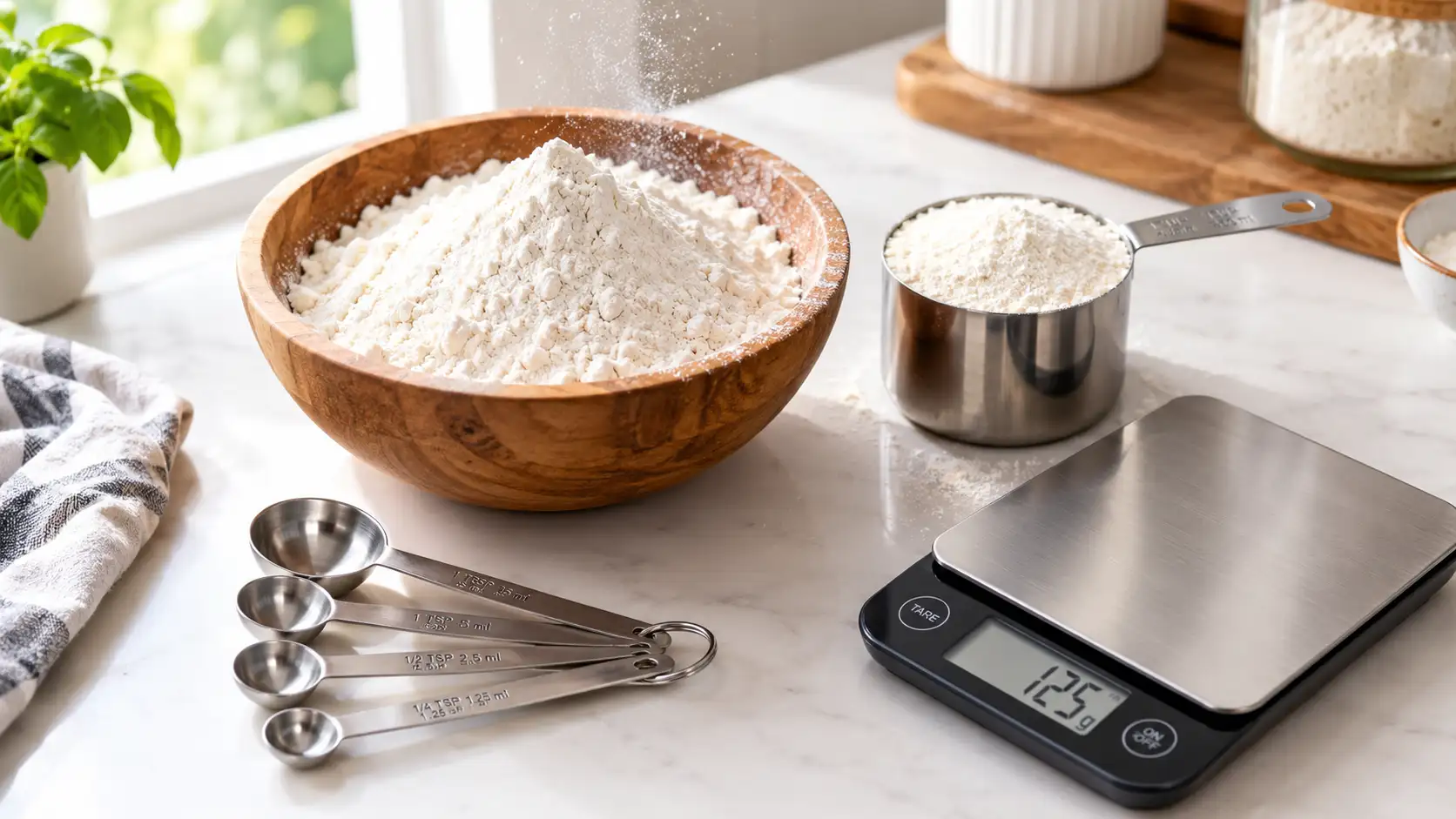
If you’ve ever found a recipe that lists flour in grams but only have measuring cups on hand—or the other way around—you know how confusing it can get. Flour is one of those ingredients where weight and volume don’t line up neatly, and guessing can throw off everything from cookies to sourdough.
This guide gives you a clear, reliable flour grams to mL conversion chart based on the approximate density of all-purpose flour, so you can measure with confidence. You’ll also learn why flour conversions aren’t always exact, how to measure flour accurately, and how to convert grams to cups when your recipe calls for volume.
How Many mL Is 100 Grams of Flour?
100 grams of all-purpose flour is approximately 189 mL.
That estimate uses an approximate bulk density of 0.53 g/mL for all-purpose flour. In other words, 100 grams ÷ 0.53 g/mL ≈ 189 mL.
Keep in mind this is an estimate, not a universal exact measurement. How the flour is scooped, sifted, or packed can change the volume by a noticeable amount. Use the chart below as a practical guide, and weigh your flour with a kitchen scale whenever precision matters.
Flour Grams to mL Conversion Chart
The following chart converts grams of all-purpose flour to milliliters using the approximate density of 0.53 g/mL. Values are rounded to the nearest whole milliliter.
| Flour Weight (grams) | Approximate Volume (mL) |
|---|---|
| 10 g | 19 mL |
| 25 g | 47 mL |
| 50 g | 94 mL |
| 75 g | 142 mL |
| 100 g | 189 mL |
| 125 g | 236 mL |
| 150 g | 283 mL |
| 175 g | 330 mL |
| 200 g | 377 mL |
| 250 g | 472 mL |
| 300 g | 566 mL |
| 400 g | 755 mL |
| 500 g | 943 mL |
These numbers work well for everyday baking, but they assume average all-purpose flour at its typical bulk density. Bread flour, cake flour, and whole wheat flour can behave differently—more on that below.
Common Flour Conversions
Here are the most-searched flour gram-to-mL conversions, calculated with the same 0.53 g/mL density.
25 grams of flour to mL
25 grams of all-purpose flour is approximately 47 mL.
50 grams of flour to mL
50 grams of flour is approximately 94 mL. This is roughly a little less than half a US cup when measured by volume.
75 grams of flour to mL
75 grams of all-purpose flour is approximately 142 mL.
100 grams of flour to mL
100 grams of flour is approximately 189 mL. This is one of the most common conversions in baking, and it’s about three-quarters of a US cup.
125 grams of flour to mL
125 grams of all-purpose flour is approximately 236 mL. That’s close to one US cup (236.6 mL), which is why many recipes treat 125 g as roughly one cup.
150 grams of flour to mL
150 grams of flour is approximately 283 mL. This is about 1¼ US cups.
200 grams of flour to mL
200 grams of all-purpose flour is approximately 377 mL. That’s roughly 1⅔ US cups.
250 grams of flour to mL
250 grams of flour is approximately 472 mL. This is about 2 US cups.
300 grams of flour to mL
300 grams of all-purpose flour is approximately 566 mL. That’s roughly 2½ US cups.
How to Convert Flour Grams to mL
Converting flour from grams to milliliters is a two-step idea: grams measure mass (how much matter), while milliliters measure volume (how much space). Because flour is a dry, powdery ingredient with lots of air between particles, the same weight can take up different amounts of space depending on how it’s handled.
To convert, you need the flour’s density—the mass per unit of volume. For all-purpose flour, a commonly used approximate bulk density is 0.53 g/mL.
The conversion is simple:
Volume (mL) = Weight (g) ÷ Density (g/mL)
So if you have 100 grams of all-purpose flour:
100 g ÷ 0.53 g/mL ≈ 189 mL
That’s it. The only tricky part is remembering that density is an estimate, not a fixed constant. The exact value depends on the flour type, its moisture content, and how it was scooped or packed.
Formula and a Worked Example
Formula: Volume (mL) = Weight (g) ÷ Density (g/mL)
Example: Convert 200 grams of all-purpose flour to milliliters.
- Weight: 200 g
- Approximate density: 0.53 g/mL
- Calculation: 200 ÷ 0.53 ≈ 377 mL
So 200 grams of all-purpose flour is approximately 377 mL.
If you’re converting the other direction—milliliters to grams—you multiply instead:
Weight (g) = Volume (mL) × Density (g/mL)
For example, 250 mL × 0.53 g/mL ≈ 133 g of all-purpose flour. These estimates are handy in the kitchen, but a digital scale remains the most accurate way to measure flour by weight.
Grams to Cups of Flour Conversion Chart
Many US recipes measure flour in cups rather than grams. To convert between the two, you need to know the assumed cup size and how much flour that cup holds.
This chart uses the US customary cup (236.6 mL) and assumes approximately 125 grams of all-purpose flour per cup, which is a common reference value for flour that’s been spooned and leveled. These are estimates—different measuring methods can change the grams per cup significantly.
| Flour Weight (grams) | Approximate US Cups |
|---|---|
| 25 g | 0.2 cup |
| 50 g | 0.4 cup |
| 75 g | 0.6 cup |
| 100 g | 0.8 cup |
| 125 g | 1 cup |
| 150 g | 1.2 cups |
| 200 g | 1.6 cups |
| 250 g | 2 cups |
| 300 g | 2.4 cups |
| 400 g | 3.2 cups |
| 500 g | 4 cups |
Remember: this chart assumes 125 g per US cup. If your flour is packed more densely—or if you’re using a different flour type—the cup equivalents will shift.
Why Flour Measurements Can Vary
Flour is notoriously inconsistent when measured by volume. A few key reasons:
- Scooping method matters. Dipping a measuring cup directly into the flour bag compacts the flour and adds extra grams. Spooning flour into the cup and leveling it off keeps it lighter and fluffier.
- Packing changes density. Firmly packed flour can weigh significantly more per cup than lightly spooned flour. Brown sugar is famously packed, but flour can be packed too—especially at the bottom of a storage container.
- Flour type affects density. All-purpose flour, bread flour, cake flour, and whole wheat flour all have different particle sizes and protein contents, which change how they settle. Cake flour is typically lighter and fluffier; whole wheat flour tends to be denser.
- Moisture and storage conditions can also affect how flour behaves. Humid kitchens and older flour may measure differently than fresh, dry flour.
- Sifting introduces air. Sifted flour takes up more volume for the same weight, so a cup of sifted flour weighs less than a cup of unsifted flour.
Because of all these variables, gram measurements are generally more consistent than volume measurements—especially for baking, where precision matters.
How to Measure Flour Accurately
If you want your baked goods to turn out the same way every time, follow these tips:
- Use a digital kitchen scale when possible. Weighing flour eliminates the guesswork of volume measurement. Set your bowl on the scale, tare it to zero, and spoon in flour until you hit the target weight.
- Fluff the flour first. Stir the flour in its container with a spoon or whisk to loosen it before measuring.
- Spoon, don’t scoop. Spoon flour into your measuring cup and let it pile up above the rim.
- Level with a straight edge. Use the back of a knife or a flat spatula to sweep off the excess without pressing down.
- Don’t tap or pack the cup. Tapping the cup settles the flour and increases the weight.
- Convert carefully. If you’re switching between grams and milliliters, treat the numbers as estimates and adjust based on how your dough or batter looks and feels.
For the most reliable results, treat the gram weight in a recipe as your primary measurement and use the mL or cup equivalent only as a convenience.
Frequently Asked Questions
Is 1 gram of flour equal to 1 mL?
No. One gram of all-purpose flour is roughly 1.9 mL, not 1 mL. Flour is much less dense than water, so it takes more volume to make up a gram. That’s why you can’t simply swap grams for milliliters one-to-one.
How many mL is 100 grams of flour?
100 grams of all-purpose flour is approximately 189 mL, based on an approximate density of 0.53 g/mL. This is an estimate and can vary with the flour type and measuring method.
How many grams is 250 mL of flour?
Using the same approximate density, 250 mL × 0.53 g/mL ≈ 133 grams of all-purpose flour. Again, this is an estimate—weighing the flour is more accurate.
Does the flour type change the grams-to-mL conversion?
Yes. All-purpose flour, bread flour, cake flour, and whole wheat flour have different bulk densities, so the same weight can occupy different volumes. The 0.53 g/mL figure is a practical estimate for all-purpose flour, not a universal constant for every flour.
Why is my cup of flour heavier than the recipe says?
It’s probably how you’re measuring. Scooping directly from the bag compacts the flour and adds extra grams. Spooning the flour into the cup and leveling it off gives a lighter, more consistent result. Using a kitchen scale avoids the problem entirely.
Can I use milliliters instead of grams for flour in baking?
You can, but it’s less precise. Volume measurements vary with how the flour is handled, while grams measure the actual amount of flour. For consistent baking results, grams are generally the better choice.
How do I convert flour grams to mL without a chart?
Divide the grams by the approximate density: Volume (mL) = Weight (g) ÷ 0.53. For example, 150 g ÷ 0.53 ≈ 283 mL. For quick conversions, an online converter like the one on GramsToML.com can save time.
Conclusion
Converting flour from grams to milliliters doesn’t have to be a guessing game. With an approximate density of 0.53 g/mL for all-purpose flour, you can quickly estimate that 100 grams is about 189 mL, 200 grams is about 377 mL, and 250 grams is about 472 mL. Just remember that these are estimates—flour type, scooping method, and packing all affect the final volume.
For the most accurate results, weigh your flour with a digital kitchen scale, and use the charts in this guide when you need a quick volume equivalent. And if you’re converting on the fly, the GramsToML.com converter makes it easy to switch between grams and milliliters for flour and dozens of other common ingredients. Bookmark it for your next baking session—your recipes will thank you.